



I am a researcher in computer vision and artificial intelligence, working to bring them into the field of smart infrastructure.
On a construction site, more delicate and precise AI prediction ties directly to safety, productivity, and cost. But precision is never free — every gain in accuracy trades against computation. The model that matters, then, is not the most powerful one; it is the one that fits its purpose and earns its keep.
That is the engineering I care about: AI vision that holds up in the real conditions of the field while cutting cost and raising productivity — practical, precise, and built for where it actually runs.

.png)


Early detection of micro-cracks can mean the difference between routine maintenance and catastrophic failure — yet the models we trust to inspect bridges and tunnels share a blind spot: the thinner the crack, the more likely they are to miss it.
The blind spot. Convolutional networks favour low-frequency content, while a hair-thin crack lives in the high-frequency band. This spectral bias leaves fine cracks fragmented — destroying the continuity that matters for safety assessment.
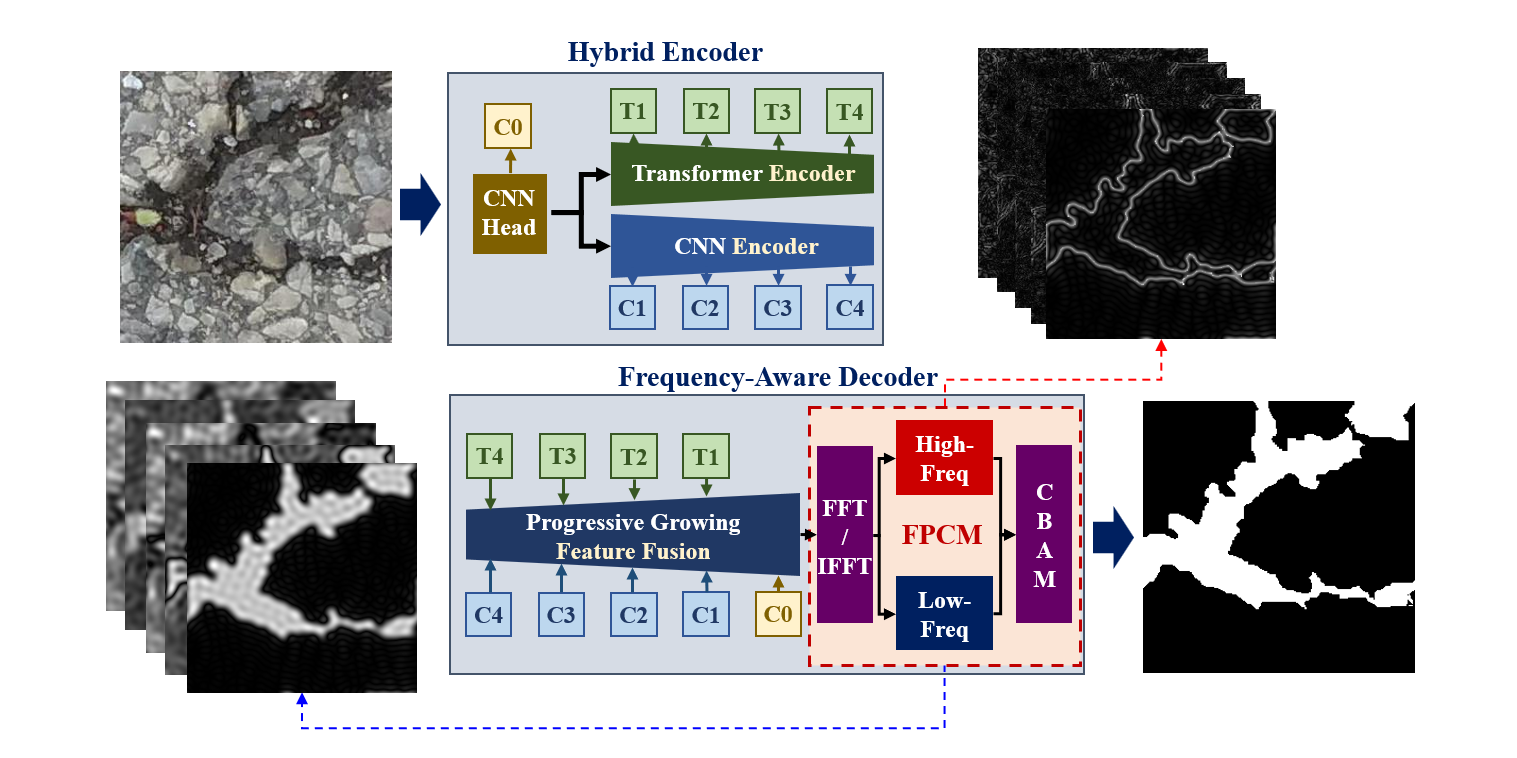
The method. FACS-Net pairs a hybrid CNN–Transformer encoder (ResNet50 + MixVision Transformer) with a frequency-aware decoder (CBAM attention + an FPCM Fourier-modulation module), trained with CT-Loss — BCE + a SEMEDA edge term + a differentiable soft-CTS continuity term.
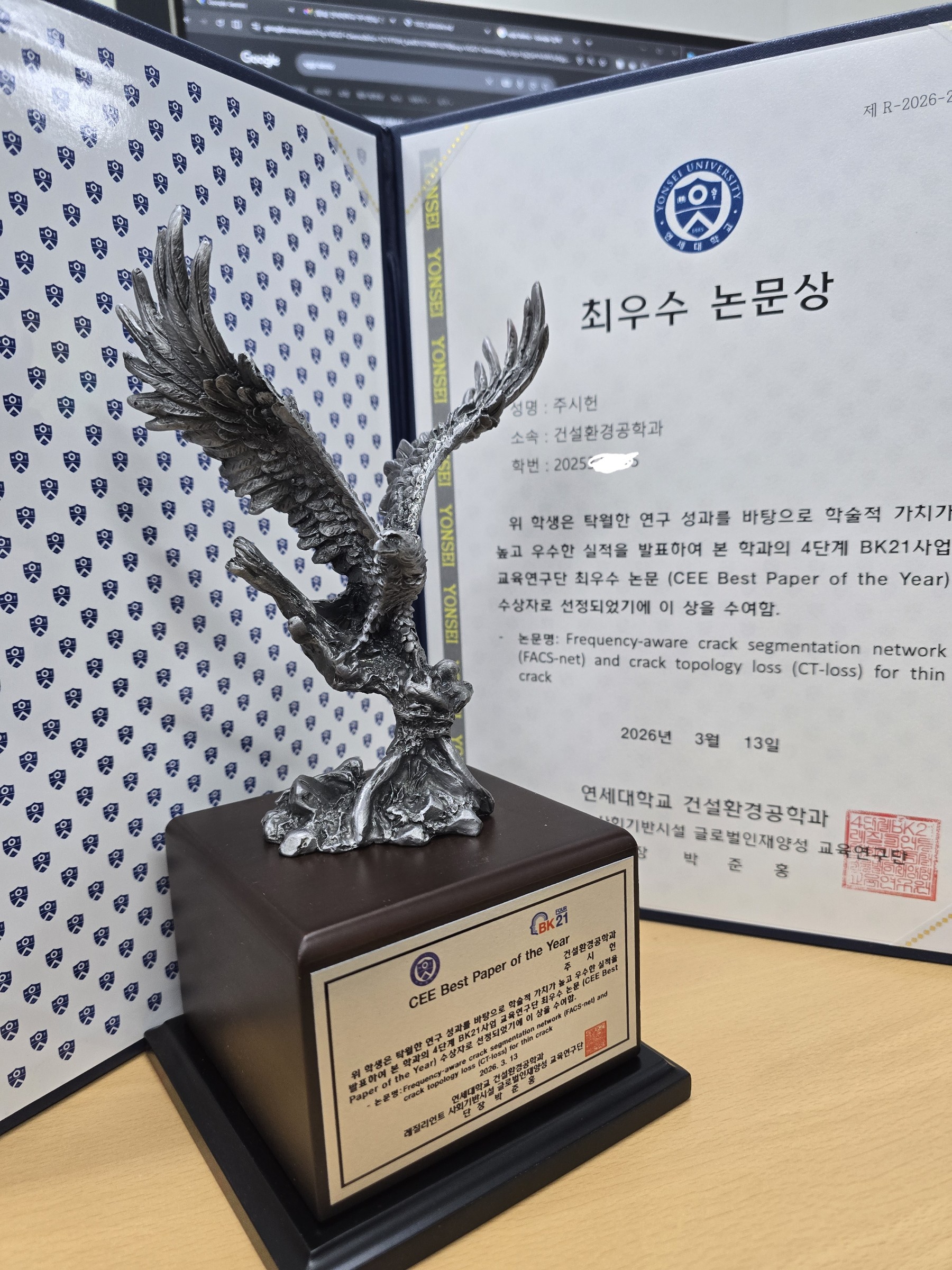
The result. On CrackVision12K, IoU 0.663 / CTS 0.651; on the thinnest cracks (≤ 2 px), IoU 0.466 / CTS 0.945 — a +0.306 IoU / +0.360 CTS gain over the prior state of the art, robust across OmniCrack30K. Published in Automation in Construction; CEE Best Paper of the Year (2026).